A Poem
Here is a lovely poem written by Alistair Te Ariki Campbell who was the first New Zealand poet I met after arriving in New Zealand and who helped to educate me in the ways of Aotearoa and taught me how to pronounce Maori place names, as well as introducing me to contemporary New Zealand writing. The text of the poem may be found in It’s Love Isn’t It? Love Poems published by HeadworX, 2008. In the book Alistair and Meg’s poems face one another on the pages.
BLUE RAIN
(written in 1965)
Blue rain from a clear sky.
Our world a cube of sunlight –
but to the south
the violet admonition
of thunder.
Innocent as flowers
your eyes with their thick lashes
open in green surprise.
What have we to fear?
Frost and a sharp wind
reproach us,
and a tall sky pelts the roof
with blue flowers.
You and I in bed my love,
heads leaning together,
merry as thieves
eating stolen honey –
what have we to fear
but a borrowed world
collapsing all about us
in blue ruins.
Aren’t those wonderful lines, “Merry as Thieves / Eating stolen honey.”? How well they capture the joy and the intimacy of love and love-making, but with that note of warning – for the honey is stolen… and, to use Auden’s phrase, ‘Time will have his fancy, tomorrow or today.”
If you enjoyed this poem, you will surely like the short sequence of seven poems called, simply Elegy and the longer sequence called Sanctuary of Spirits. A full list of Alistair’s published work can be found on Wikipedia.
My first meeting with Alistair occurred when I was invited by Bill Austen to work on a stage version of Alistair’s radio play When the Bough Breaks. After the first meeting I read as much of his poetry as I could find, and I was swept away by it. I suggested, somewhat tentatively, that he should use some of his love poems in the play, to support the strong emotional content. And he obliged. Some time later I worked on a staged reading of Sanctuary of Spirits and listened as Alistair talked about Te Rauparaha for whom he had a strange and deep attachment. The house where Alistair and Meg lived stands on a headland, facing across to Kapiti Island where Te Rauparaha lived and fought.

Kapiti Island, from Waikanae Beach, NZ. Photo: James Dignan.
In those long distant days, my wife Nonnita and I would drive our rattly old Ford Prefect (yes!) out to Pukerua Bay and thence to the Paekakariki Pub where we might meet up with some of Alistair and Meg’s friends and, enjoy a beer while swapping gossip with whoever happened to arrive.

Alistair and Meg in 1958.
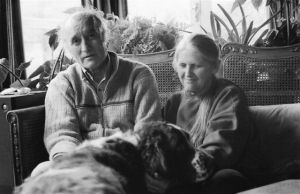
Alistair and Meg much later. (Photos: Mark Pirie of HeadworX. Original source unknown.)
Alistair was born in 1925 and died in 2009. Meg, his wife, also a poet was born in 1937 and died in 2007. Both are greatly missed.

Photo of Alistair by Robert Cross, a photographer who has made superb portraits of New Zealand writers. That is Kapiti Island in the background.
What’s new?
Nov 12. I have added a long poem called The Ballad of John ‘Death’ Elliott. You can find it under Poems from the Books. It was intended to be part of The Fall of the Families, but got missed out in the Gollancz edition. While it is clearly derivative from both Eskimo Nell and Coleridge’s The Rime of the Ancient Mariner, it was not conceived as a pastiche and took on a life of its own. See what you think. Of course, it helps if you have read the book.
What the Critics did not tell…. but I will.
I have started a new page called Whispers from the Wings. This will be a long-term project as I want to write about some of the productions I have done and try to explain why I believe these plays matter and what I discovered when I was directing them. In my teaching, I always felt much more secure if I had had a passionate affair with the text, for that is finally what a production is.
I have directed quite a number of plays – from experimental to classical, from new to old and… forgotten – and on many different types of stage. Every production has been a quest of one kind or another. All too often directors say some thing like “I let the production speak for its self.” And of course, they are right: the theatre exists in the NOW, in the second of seeing, in the revelation or laughter of the moment; and perhaps something lingers for a few days or weeks afterwards. Some productions have an extended life as a few fading photos: but it is always surprising to me how quickly the photos age.
The sad thing is that productions sometimes only live on in the written words of the critics, who themselves work to deadlines, and whose reviews are often written during a coffee break minutes after the play is over. Their words, for better or for worse, become our history. The brilliant insight provided by Kenneth Tynan when writing on Brecht is a rarity in my experience.
I want to write about plays from the inside, about the dynamics of rehearsal, about the guesses and the gambles, about the wonderful moments when the play lifts from the page and you see the actors take fire. And I’ll write about some of the heartaches too. And I shall not be attacking the critics or pleading my own case or indulging in gossip. Sorry.
A Project in Prospect
The composer Michelle Scullion and I have decided to collaborate on a work for young readers. It is called Tales from the Borderland and is about the life and the adventures of creatures that live in a rock pool. We are now looking for an illustrator… Any offers?
An Honour
I was recently awarded the Sir Julius Vogel award for services to Science Fiction. So there you are. Now you know.
 Phillip Mann - writer, teacher and theatre director
Leave a comment