
JAMES BROWN
The end of a race. There’s no stopping that lad!
**Just a quick note before you begin to say that at the end of this post, I am adding some new information on what has been happening on the writing front as regards my own work. Now, please read on…**
Introduction
The person I wish to celebrate in the next couple of articles is my cousin James Brown – but there are a few things I feel I need to mention before handing over to him. I have called the series A Hero for Our Times because that is exactly what I feel when I contemplate his achievements.
First, in his youth James was a superb athlete. He represented Great Britain several times in Orienteering – a sport which requires intelligence, complete fitness and stamina. I once described him as the kind of man who, if he saw a steep hill, felt an irresistible temptation to run up it: and then do it again – but faster. I say this with all the admiration of a non-runner. Over the years of our friendship, I have observed the slow onset of multiple sclerosis which has put paid to James’ days as a runner, but which has never dimmed his spirit.
Second, – and this will be the subject of my second article – James is a painter of large canvases which celebrate the earth as seen through an orienteer’s eyes: paintings which bring to life the birth of streams, the flow of energy across the face of the earth, and his delight in raw colour and contrast.

Ruth’s Wharfedale, Ilkley and Cow.
James likes to experiment with new materials. He has recently been moving into writing fiction and poetry…. Is there no end?
These two articles, then, are a personal tribute to a man who is, in some ways, the younger brother that I always wished for and never had in reality: a companion to joke with and who is also at home with wide-ranging speculation.
The Mystery of the Ti0 Mila Rescuer 1981.
Part 1. THEN.
In 1981, when he was 19, James Brown spent some time living in Norway with fellow English orienteers Roger Bloor and Dave Cheesewright. They earned their keep by designing special orienteering maps to be used in races located in the beautiful and rugged Norwegian forests. Being athletes themselves, the three young men spent as much time as possible training and competing in whatever races were available. As James comments “Our plan was to become the best orienteers in Britain.”
For those unfamiliar with Orienteering, it is the name given to a race which tales place through terrain which is unknown to the competitors. He or she runs (or rides their mountain bike) navigating their way using only a compass and a detailed map of that specific terrain. They are racing against the clock, and need to find and register their presence at specified checkpoints each of which is marked on the map. Orienteering races are usually held amid mountains and forests, and in all types of weather; but the principle of navigating an unknown route can be applied to races taking place in complex city centres like Venice orYork, or even through museums or shopping centres! However, orienteers of James’ kind like nothing better than to race in the wild, taking streams in their stride, and to arrive at the finish, muddied and winded, but triumphant (oh yes!) and ahead of the game.
Usually the sport is held for individual competitors, but there are specially staged relay races where groups of competitors come together to form a relay team. In relay races the runners see their map of the course for the first time the moment the race begins and they hare off, or the more elderly perhaps, tortoise off into the forest navigating towards the first control point. They then must continue to visit each checkpoint in the order they appear on the map until they have visited them all. They complete their race by handing over to their next team member and so on until the final team member has successfully visited each control and crossed the finish line. Naturally, those who complete the arduous course first, are the winners. Rigorous checks are made to make sure the competitors have visit all the checkpoints. Failure to do so means disqualification.
It was during one such relay race that James had a most disturbing adventure. The race was called the Ti0 Mila (pronounced ‘tia meala’ in Swedish) and it took place overnight in a forest in Sweden. Several teams, each consisting of 10 seasoned orienteers were competing, and James, who was already well known in orienteering circles, had been invited to join a Norwegian orienteering club called OL Pa. James was to run the final leg of the 16 km course.
He describes what happened as follows.
“I had been running for an hour and a half and had completed about 14 kilometres of the 16km final leg. I was starting to feel the strain. It was already getting light but the air was still very cold, well below zero. Uncertain of my own location in the forest I paused to scrutinise the map and only then did I become aware of a man wearing an orange hat standing rigidly like a statue in a semi open area some 30 metres in front of me. It was as though he was frozen to the ground. He didn’t look at me or react in any other way, which was strange. Normally runners acknowledge one another especially if they are lost. But he didn’t appear like other orienteers at all, though he clutched a map in his hand. Even in the poor light of dawn, I could see that he looked as pale as a ghost. Then, as I watched, he leaned slowly forward and toppled over without even putting out his hands to protect himself. It was the bizarre way he fell that most alarmed me. I guessed that he must be semi-conscious. I was shocked and ran cautiously to where the man was lying motionless, face down in the snow. Having now stopped running for several minutes, I too was feeling the cold and was uncertain what to do.
I scanned around hoping to see head torches or at least hear the sound of other runners approaching but there was no one. I realised I was totally alone with him.
I rolled him over and spoke encouragingly to him, but I saw he was in no state to answer and his eyes stared absently past me. But he did mumble something indistinctly. I knew I hadn’t the strength to pick him up and carry him though he clearly needed immediate help. I decided that although my team wouldn’t thank me for quitting the race, this man probably would. So I placed my gloved hands under his armpits, turned my back in the direction of the finish and began dragging him.
I dragged him slowly through the forest stepping cautiously backwards, snatching glances over my shoulder to check the route. I kept talking to him in the hope of keeping him conscious and as I walked backwards I looked at his legs making grooves in the snow and thought of the cold that must be seeping into him. I wished I could move faster.
The route I had chosen took us downhill. I’d spotted a wide path on the map and I hoped we’d find people there who could help. As I made slow progress my mind began wandering. I looked at the tops of his legs trailing there, and noticed he was wearing the type of baggy jogging bottoms that are held close at the ankles by tight elastic. These had been made fashionable by the then popular TV series called Fame which dealt with the trials and tribulations of a group of student dancers in America. This way of dressing had been adopted by many of the people who joined the 1980’s jogging boom.
Suddenly the terrain changed. We entered an area where the trees had been felled. In some ways this made my task harder. Still walking backwards I caught my foot in a fallen branch and fell over backwards. I struggled up and continued hauling the now silent man towards the distant path.
Seeing his fashion pants, I wasn’t surprised to notice he didn’t wear the kind of shoes specially designed for this terrain. His trainers, which seemed to be coming untied, were an expensive pair of Nike Elites. These were the very trainers I’d saved up to buy for my own training and cross country races. Just as I thought this, the heel of his right foot was gripped by the cleft in a branch and his shoe was whipped off. He did not react to this and I saw his eyes were now closed. Still I dragged him onwards.
As we neared the path I was relieved to see runners coming out of the felled area and racing into the final kilometre before the finish and my hopes soared. At last help was in sight though we still had another 100m of rough terrain to cross. I realized grimly that if I hadn’t stopped to help the man I would probably have already reached the finish.
We finally reached the path. I called out for help but was so exhausted that my voice was faint. I remember feeling furious that the runners ignored us and ran right by.
Then, from nowhere it seemed, a competitor suddenly joined me and took one of the man’s arms and we dragged the freezing man together.
I wish I could remember the faces of the people who helped that day but the whole episode was becoming a hazy blur. It almost feels like fiction now. I remember my new helper shouting loudly in Swedish and a 3rd man joined us. Suddenly there was much shouting and pointing and the injured man was lifted and carried quickly away in search of a first aid point. The weight of my responsibility had finally been lifted from me and I wandered in a daze to the finish line where I handed over my incomplete control card. I knew that the whole team would be disqualified as I had not registered with the 3 final check points.
I was so shaken up that I couldn’t tell anyone about what had happened. You must understand that I was a stranger to my Norwegian team mates since I was a replacement for their missing leg 10 runner. I’d been asked to take his place only days before the race – and in any case I did not speak their language. I’m sure they wanted to know what I’d done to get all 10 members of the team disqualified, especially so close to the end. But if they came looking for explanations, I had by then disappeared. I just wanted sleep and was on a coach heading back to Norway. I made my way down the aisle of the bus and couldn’t even tell my sleeping English friends about what had happened before I flopped down exhausted on the coach seat and silently cried.”
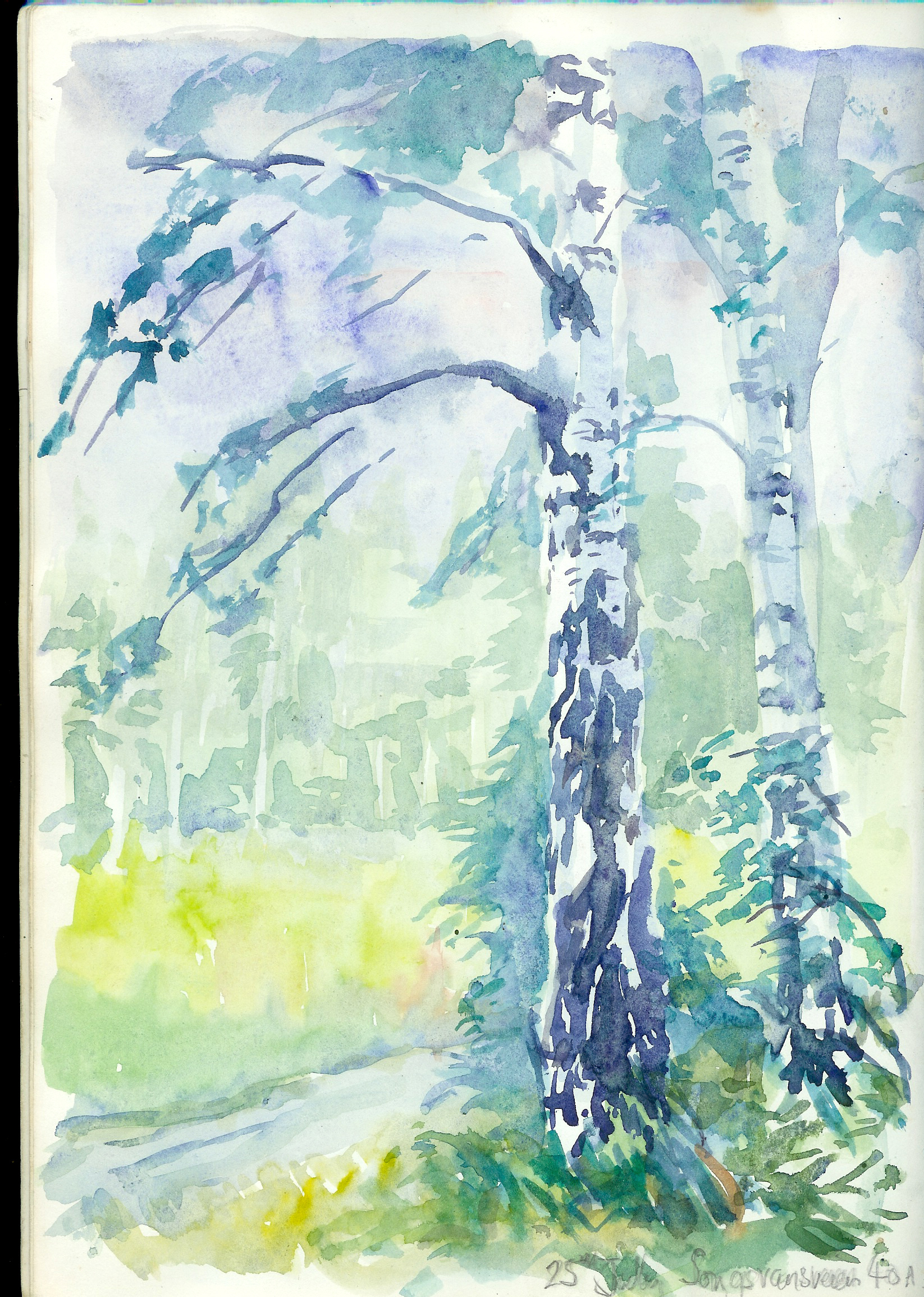
NORWEGIAN SILVER BIRCHES
Painting by James Brown
***********
Part 2. NOW
All that was 30 years ago.
When James first told me this true story I was deeply moved. I am aware of the ways in which memories, seemingly suppressed, can mature in the mind until it is their turn to be reborn. It seems that the rescue story, after lying dormant for many years in James’ mind, had again come alive. He had begun waking in the night, thinking about the stranger he had rescued in the forest, wondering whether he had survived, and if so, whether he now had a family of his own. James was aware of his own young daughter just beginning to discover the joys of orienteering and of his twenty-year-old son who is also a runner and now at university.
Here was a story they could relate to, but it had loose ends and many questions remained..
It was time to find some answers.
In James’ words…
“When I wrote the above story, it was initially a personal project. I wanted to put into words what had happened to try and make sense of the memories that had returned to me and had begun keeping me awake. I then decided to use it to try and close the loop and find out whether the stranger I dragged through the forest had survived, and if so, what had happened to him. I sent the completed story to Skogssport, the magazine for Swedish orienteers, thinking they may put a paragraph in the next edition to see if anyone remembered the incident or knew anything about it.”
They did far more than that. Staff at Skogssport managed to track down the man who had been saved and who turned out not to be a regular orienteer at all, but the international cross country and marathon runner Hans Nilsson. He told them his side of the story.
Nilsson’s task, all those years ago, had been to follow and keep up with the race leaders. Like James he was running the 10th and final leg of the race. His team probably had high hopes of success knowing he had run a 2.16 marathon and 1.04 half marathon. These competitors were fit men, used to pushing their bodies hard.
Hans Nilsson recalls that the orienteering went well until only 2km of the course remained. Suddenly he felt a complete lack of energy and became dizzy. The next thing he remembers is waking up in hospital. He does not remember the ordeal of being dragged through the forest. Luckily he had no permanent mental or physical damage, although he did have some initial heart problems when he arrived at the hospital with a body temperature of only 31ºc and atrial fibrillation. However Hans was running again within the week and got married 17 days after the race.
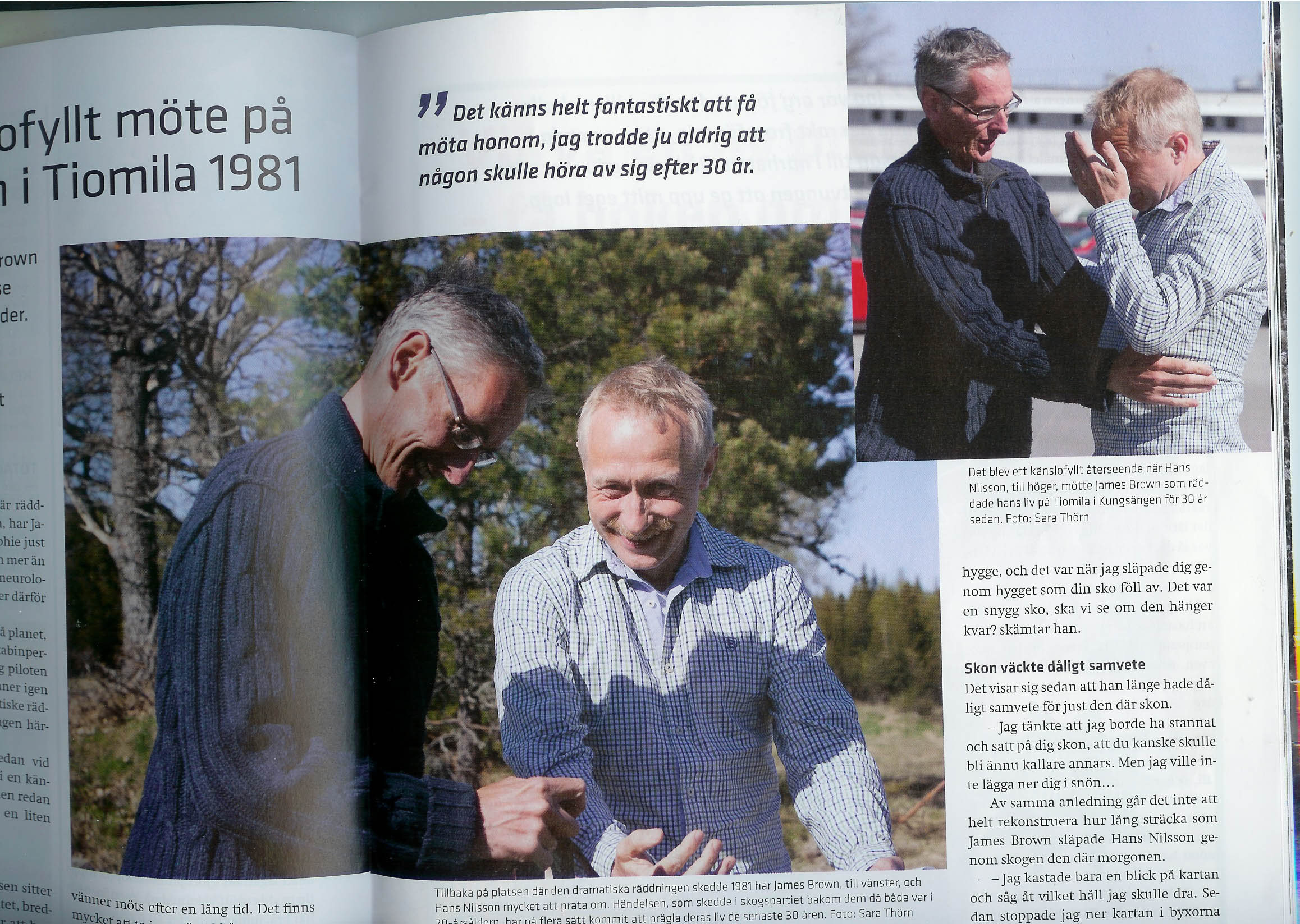
In the following photo, James meets Hans Nilsson for the first time in 30 years.
.
Now, Hans and his wife Inga-Lill have three sons in their twenties. He still runs 10km each day and coaches for a top athletics club.
The response to the story in Scandinaviawas astounding. The media got hold of it and Hans was interviewed on Swedish TV. Next the story featured in several national papers in both Swedenand Norway. It also received two double page spreads in the magazine Skogssport. Members of the Norwegian team in which James was running as 10th man made contact with him and sent him some very touching e-mails. Harder Sandvik, the OL Pan team leader, sent an email saying:
‘Now that I know why the team were disqualified, I am Proud to have had such a man in my team’.
Apparently, after the race James had been known to their team as the ‘Stranger Man’.
In James’ words:
“In March I received an invitation to attend the Tio Mila 2011 race as the VIP guest of the event organisers and the Swedish Orienteering Federation.
So, at the end of April, Sophie, my wife and I flew toSweden. We were completely unaware of the scale of media attention the story had received. Aboard the plane, the pilot recognised me as ‘the man from the newspapers’. He came to shake my hand before I disembarked from the plane. Other passengers on our short trip seems to recognise me too!
A regards Hans, I had an emotional reunion with him in the very forest where the rescue had happened 30 years ago. The media were there to capture it all for the papers. This was followed by a perfect weekend at the Tio Mila race centre. At the start of the men’s race I was invited onto a rostrum to watch the head torches of 600 runners racing into the forest. Later, the Swedish Orientation Federation made a televised presentation to me of a print of a painting of a orienteer who appears about twenty years old and is looking around vigilantly as he runs through a Swedish forest. Below it, there is the bold inscription,
‘In recognition of James Brown. Svenska Orienteringforbundet.’
And it bears the signatures of the Chairwoman and President. It expresses their gratitude for my actions of 30 years ago.
Sophie, who is a runner in her own right, was invited to run for a Swedish ladies’ team. I, meanwhile, had the chance to catch up with old orienteering friends whom I had not seen for years.
In July of this year (2011) Hans and Inga-Lill came to stay with us in Menston. Although Hans admits orienteering isn’t for him, we did our best to convert him from being a great road runner (which he is) to a gnarly fell runner. I am glad to report that he got completely hooked on Ilkley Moor. We plan to visit Hans and Inga-Lill in Sweden next summer along with a trip to the Swedish 5-days.”
And there you have it: the humility of the man.
When James wrote the story about the rescue he simply wanted to find out who the man he had rescued was and whether he had survived. He never anticipated all that has happened since! I suspect that most heroes of both sexes are simply people who let their best instincts take over at a moment of Crisis.
It falls to the rest of us to celebrate them.
James then, entertaining….
When all the world is young, lad,
And all the trees are green;
And every goose a swan, lad,
And every lass a queen.
(Charles Kingsley)
Phil here…
I hope you enjoyed the article on James the Orienteer. Before long we will be putting together an article on James the painter and poet.
And now for something completely different.
SF Gateway
A few months ago I received, via this website, a most interesting letter. It was from Malcolm Edwards, formerly of Victor Gollancz and now Deputy CEO of Orion Publishing who was trying to contact me but who had been told that I was dead!
The confusion arose, I think, because I had written a piece called In Memoriam and some people thought it was for me rather than by me. Malcolm made a nice joke on the famous quote by Mark Twain that “rumours” of his death had been “greatly exaggerated.” He was glad to find I was still alive. He had important news…
Malcolm was my first editor and the man who plucked my first book, The Eye of the Queen, ouut of the ‘slush pile’. Indeed it was he who came up with the title of the book. He subsequently edited the Paxwax books, and it was at his suggestion that the original ms. be developed into two volumes – and this remains the hardest writing challenge that I have ever faced. After that he edited Pioneers… and almost edited Wulfsyarn – A Mosaic, except that he left Gollancz for fresh woods and pastures new..
I owe a great deal to Malcolm whose knowledge of publishing and of Science Fiction helped me immeasurably. He was trying to contact me because Orion Publishing was setting up an E publishing Website devoted to Science Fiction; the works being mainly drawn from ‘the last century’ and he was interested to know if I would care to be included.
I would! My books had been out of print for some time, and though I had written new work, those who were now managing Gollancz SF lists were not encouraging and one book was rejected. Suffice to say that I ended up by reclaiming the rights to all my books since there seemed to be no interest in republishing them. However, that is whole other story, which may one day be told. In any case, I am conscious that the literary world is full of writers who feel that their work has not been given the recognition it deserves: I do not really want to be part of their ranks.
So, when Malcolm explained what was happening I was delighted, especially as I had been thinking about E publishing for some time and felt it was the perfect medium for disseminating Science Fiction..
That period, i.e. the second half of the Twentieth century, was remarkable in many ways, not least being that it saw Science Fiction become a major genre, building on the mighty shoulders of socially aware writers as varied as H.G. Wells, Jules Verne, Aldous Huxley, George Orwell et al. Among publishers in England, Victor Gollancz was outstanding. The distinct yellow covers which clothed their books were a sign of excellence and always looked for when visiting the library. The variety of the writers they had published was enormous. You can see for yourself.
And now that Website is up and running. So if you are a SF fan go to http://www.sfgateway.com/
And even if you are not an SF fan, have a look, as SF is a vast and varied field of literature… it is not all dungeons and dragons.
The SFGateway Webpage is expanding all the time in terms of both the number of authors represented and the range of titles available. In addition to books, there are brief introductions to authors, synopses of their works and a forum for discussion. I think it is worth a visit to the website even if you do not buy a book. For myself – and in this I think I speak for most writers – I would love to see plenty of comments offered especially if they reveal why a book is loved or considered important. This is not just a matter of wanting to read nice things about one’s work – pleasurable though that may be. SF thrives on ideas and speculation and that leads to debate and discussion. Moreover, SF works, perhaps more than any other genre, reflect the time when they were written.. and that too is a cause for interest. However, good yarns last forever.
WULFSYARN – A Mosaic
I was once told that this book could not be adapted for radio. But now I have received word that it is due to be broadcast in 20 episodes by Radio New Zealand sometime in 2012. . The adaptation has been completed by Owen Scott and he has done a brilliant job with that unruly text.
I will write more about this in my next blog. Those of you who do not know Wulfsyarn should go to the part of this website which deals with my novels. I have placed a sample of it there as well as some notes about the strange things that happened during its composition.
Till then. Happy reading.
 Phillip Mann - writer, teacher and theatre director

Leave a comment